 Français


About fifteen children line up on the cobblestones, in the shade of the vast branches of the kapok tree. Beneath the Gustavia lighthouse, on the site of Fort Gustav III, they have gathered on this Sunday, May 10, to commemorate the 25th anniversary of the Taubira Law, which designated the slave trade and slavery as crimes against humanity. While some officials chose running over history, territorial councilors Bettina Cointre and Francius Matignon represent the Collectivité alongside the prefecture’s secretary general, Fabrice Thibier. Elected official Cécile Rubino Tessier is also present, but to accompany the fifth-grade students from her class at Sainte-Marie de Colombier, with whom she carried out a project to participate in the national contest titled “The Flame of Equality.” A project that allows students to engage in civic reflection by drawing on the history of the slave trade, slavery, and their abolitions, as well as their lingering effects and legacies.
The students explain their approach, which follows a presentation in their classroom by the Saint-Barth Héritage association on October 7, two days before the official commemoration of the date marking Sweden’s abolition of slavery in Saint Barthélemy in 1847. “We were able to learn about the history of slavery in the Caribbean and in Saint Barthélemy,” explains one child before highlighting the art projects completed in class. These projects then allowed the students to “represent past and future memories using symbols related to equality in the broadest sense,” he adds. The resulting artwork also reflects on women’s rights.
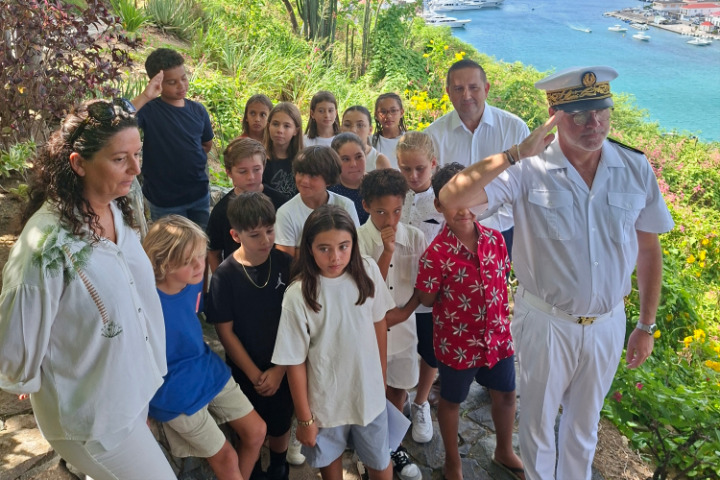
Following this presentation, the prefect’s representative noted that the Taubira Law “marked a major milestone.” Fabrice Thibier continued, reflecting on the memory of slavery: “In Saint Barthélemy, this memory is not abstract. It can still be seen in certain parts of the territory, sometimes without us even noticing it. In Gustavia, a former guardhouse, where slaves were once held and punished, has become a parking lot. Other buildings linked to the arrival and confinement of slaves still exist today. Nothing has disappeared. That is also why the work of remembrance is necessary.”
After the schoolchildren sang the Marseillaise and then the gospel song “Oh Freedom,” wreaths were laid beneath the plaque commemorating the abolition of slavery. A certificate of civic engagement was then presented to the students by the secretary general of the prefecture. It was a reward for their involvement and the work they had accomplished, pending the decision on whether their project, “Light for Equality,” would be recognized at the national level.