 Français

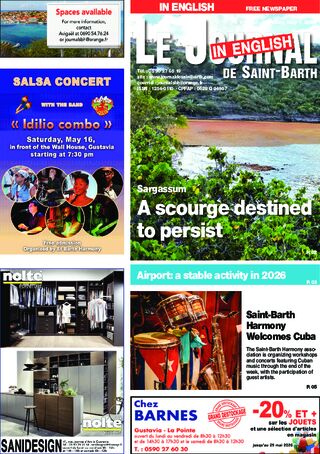
Sargassum arrives in patches before washing ashore by the ton. Since 2011 and the appearance of brown algae blooms along the coasts of the Caribbean islands, the phenomenon has continued to grow. An invasive, polluting, and destructive presence that was intended to be seasonal but now seems destined to persist for a much longer period. As confirmed by Fabrice Thibier, Secretary General of the Prefecture of Saint Martin and Saint Barthélemy.
“A massive belt of Sargassum”
During the meeting to present the Sargassum III plan held on May 6 at the Collectivité’s headquarters, issues specific to Saint Barthélemy were discussed in the presence of the plan’s national coordinator. “We finally have a fairly recent scientific consensus,” says the prefect’s aide. “We used to think that Sargassum was multiplying because of the Mississippi River, the Amazon, and smoke from deforestation in Central Africa or South America. In fact, we’re realizing that it’s a bit more complicated than that. In 2011, a shift in the Canary Current tore off a section of the Sargasso Sea and carried it into the North Tropical Current. Over the course of ten years, this created a massive belt of Sargassum that is no longer seasonal and now contains over 35 million tons of organic matter. That’s why we have a persistent phenomenon that’s going to last longer. Before, it was between July and September; now we’re likely to see it from March through November or December.” In short, a longer season and more frequent, more intense peaks of strandings.
“We’re going to learn”
After years of inaction during which the focus was solely on collecting washed-up seaweed, the Territorial Collectivity has finally decided to launch a response program. At the initiative of the elected official in charge of environmental issues, Rudi Laplace, a contract to install diversion dams has been initiated. The first is scheduled to be installed in Marigot Bay next August, it was announced. A “test” barrier before installing others over the next three years to protect the most affected bays. The Territorial Collectivity plans to invest more than seven million euros in this trial. Not to mention the budget allocated for daily cleanup on the island’s beaches. “We’re going to learn,” Rudi Laplace stated during the May 6 meeting, adding: “There’s no magic solution; we have to fight.”
During the previous term, in 2018, the installation of barriers was considered but then abandoned. This was deemed ineffective without the support of another measure—such as a boat for collecting debris at sea. A solution that, for the time being, has not been mentioned by the Collectivité.
Measures but no solution
Elsewhere, floating and deflecting barriers are already in use. In Guadeloupe, for example. Between Petit-Bourg and Baie-Mahault, a barrier stretches 3.3 kilometers. In Arnouville, where sargassum is diverted when the current isn’t acting up, a platform has been built to collect the seaweed before it washes ashore. In Terre-de-Haut, on Pompière Beach, an experimental barrier has also been installed. In both cases, the system only works when combined with collection at sea and on the shoreline. This is because some seaweed manages to get through and disrupts residents’ lives. The system therefore has its limitations.
In Martinique, in addition to the barriers, a sea-based collection vessel, the Sargator (now in its third iteration), is being used. This vessel costs 300,000 euros. Designed in Guadeloupe, the ship can collect up to 80 tons of seaweed per hour. The sargassum is placed in large bags before being sent to the bottom of the sea. This solution poses some environmental challenges.
In Saint Vincent and the Grenadines, Barbados, Puerto Rico, and elsewhere, experiments are underway—both for coastal protection and the processing of Sargassum—with the help of university researchers and companies specializing in innovation. A French inventor, Thibault Chatillon, CEO of the company Tami (Terre air mer innovation), has even designed a marine drone intended to collect sargassum, as reported earlier this year in an article in Ouest-France.
In Saint-Barth, the volume of seaweed collected from the beaches is said to have increased by about 40% over the past three years. Not to mention that the problem of storage and disposal still needs to be addressed. This is a massive undertaking and one that is crucial for the island’s future health and economy.