Français



The ceremony commemorating the abolition of slavery in Saint Barthélemy took place on Friday, October 9. Beyond the official speeches delivered at Fort Gustav III, it was the remarks by the island’s schoolchildren that made this annual commemoration so memorable.
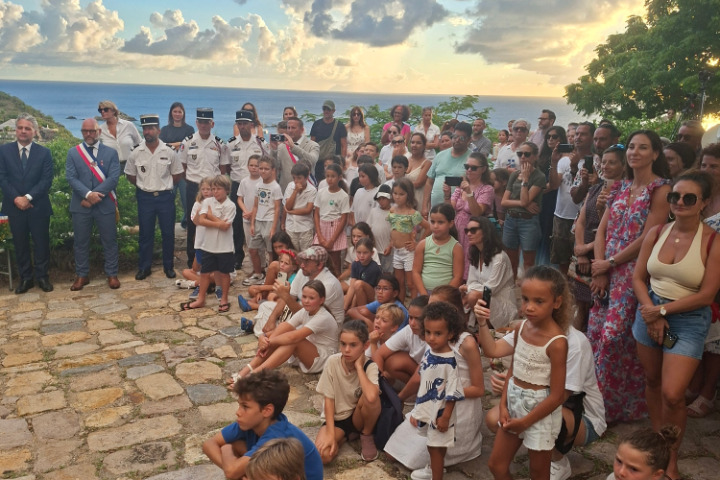
Never in its short history has the ceremony commemorating the abolition of slavery in Saint Barthélemy drawn such a large crowd. On Friday, October 9, many people made their way to the heights of Fort Gustav III. Among them were officials, of course, as well as some island residents committed to this event of history and remembrance, but above all, parents and school staff. For beyond the speeches delivered by the president of the territorial council, Xavier Lédée, and the representative of the prefect of Saint Martin and Saint Barthélemy, Joris Eberhardt, it was the island’s schoolchildren who set the tone for the ceremony.
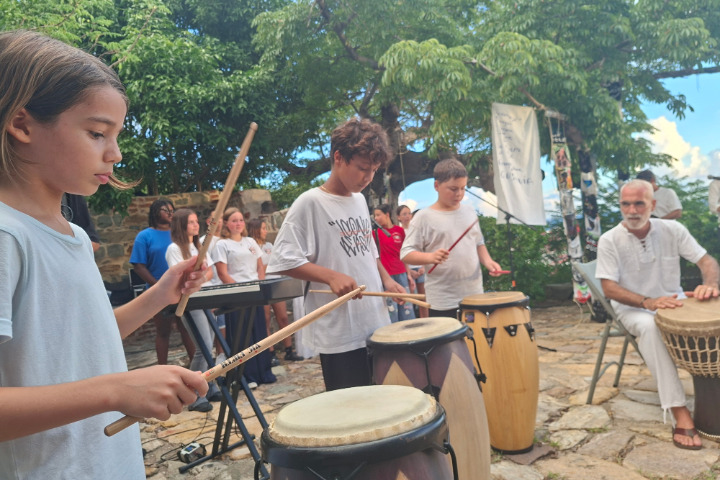
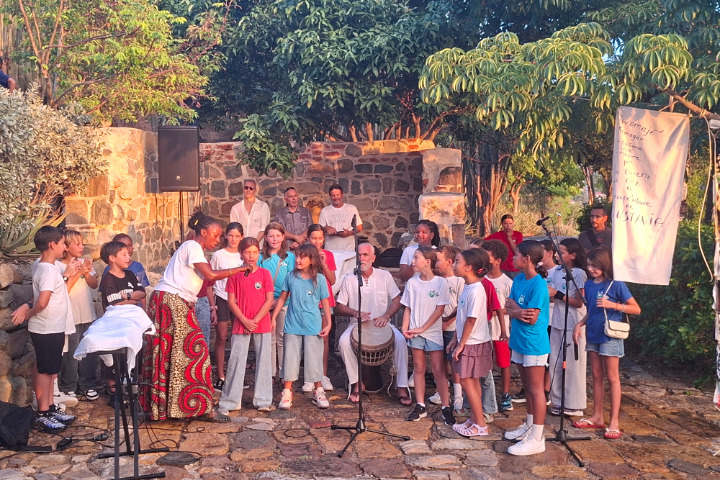
Through songs, music (thanks to the equally notable participation of the students of Mireille Choisy Middle School’s music teacher, Julien Séguret), recited texts, and also through the projects they have been working on for the past two years at the Gustavia school complex. Nathalie Galou and Anne-Sophie Teyras, teachers at the school, guided and supported the students in their research and creative projects. “On this day commemorating the abolition of slavery, we are very proud to read to you the words of René Depestre, a committed Haitian poet,” said Nathalie Galou. “We are also pleased to present the mural created by the fifth-grade students at the Gustavia School District in the 2025–2026 school year. This project involved extensive research and reading of the works of Richard Lédée and other scholars who have studied the Caribbean.” ” This pride was shared by the parents and teachers in attendance.
Questioning, getting angry…
“Our idea was for the fifth-grade students to participate in this ceremony through their work,” explains Nathalie Galou. “They studied the period of abolition. We try to combine the subjects they enjoy, such as visual arts and writing. First, we studied the kapok tree—a tree at the heart of slavery, representing fear, suffering, but also freedom—and then we asked them to create an art project.” It was a long-term project that clearly captivated the children. “They enjoyed working on this,” their teacher assures us. “They learned new words, the stages of slavery, and the struggle for freedom. These projects allowed them to ask questions and, at times, to get angry… Working on this project stirred up a lot of emotion among the students. So we’re very proud to present their work.”
Anne-Sophie Teyras, also a teacher at the Gustavia school complex, emphasizes the importance of the methodology behind such research projects with young children: “To address this topic, we begin with a historical overview of this long and painful period that began in the 16th century, through readings of accounts from that era, followed by discussions with the children. All of this allows them to then express—through words and images—not only the suffering but also the joy of liberation, as well as memory and remembrance. We develop a wide range of skills and disciplines through this project. In the 4th- and 5th-grade history curriculum, we cover the French Revolution—a period marked by significant violence and often viewed as grim and inhumane. Certain moments in history are violent, and yet they must be taught. There are ways to do so without presenting shocking depictions. Through texts, images, and discussions, it is possible—to explain today the importance of respect for others and of freedom.”
Hanging from the branches of the kapok tree, the murals created by the schoolchildren were on display for the public to view at the end of the ceremony. It was a reward and a source of pride for the work they had done. This work of remembrance is essential, 179 years after the Kingdom of Sweden abolished slavery in Saint Barthélemy.
Richard Lédée, at the End of the Struggle
If there is a date to commemorate the abolition of slavery in Saint Barthélemy, it is thanks to the tenacious research conducted by Richard Lédée. On June 12, 2009, the territorial council unanimously adopted a resolution recognizing October 9 as the official date of the abolition of slavery in Saint Barth. It took the French government three more years to formalize this same date by decree. However, it was not until 2023, at the initiative of Prefect Vincent Berton, that an official ceremony was held. Since then, with October 9 considered a public holiday on the island, Richard Lédée has been fighting to ensure it is observed.
“There’s a lot of confusion surrounding this issue,” he explains. “When the holiday was established, for example, the commercial port was closed. Then it reopened, closed again—we don’t know where we stand. On the port’s calendar, this date has been completely overlooked. Something isn’t right. According to the Labor Code, it’s been a public holiday since 2016.”
Consequently, determined to make his voice heard, Richard Lédée acted on his convictions. On Friday, October 9, in a small boat, he attempted to disrupt operations at the commercial port. But the gendarmerie intervened to force him back ashore. This protest earned him a summons to the police station. But there is no doubt that Richard Lédée will continue his fight to ensure that October 9 is recognized as a public holiday.