 Français

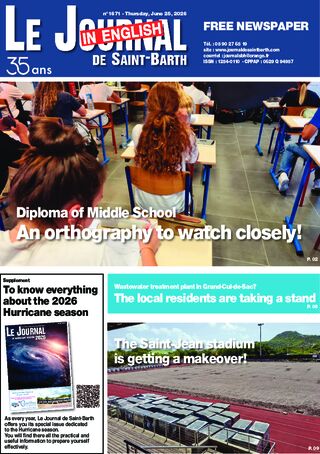
“We didn’t get it right away, and we’re wondering where this came from.” Seated around a table, several residents of the Grand-Cul-de-Sac neighborhood are still wavering between shock, fear, and anger. A few days earlier, through a friendly phone call, a resident learned that a sanitation zoning plan could “turn her life—and that of her neighbors, her children, nature’s most devoted advocates, and the island itself—upside down.” The subject of this revelation is included in the island’s wastewater treatment zoning plan, which was made available to the public between June 8 and 22. It involves a plan to build a wastewater treatment plant (WWTP) in Grand-Cul-de-Sac “to ensure the connection of the Grand Cul-de-Sac, Petit Cul-de-Sac, and Marigot areas,” as specified in the document.
The announcement that the documents were available to the public was released on June 10, two days after the public review period began. The dossier includes an estimate of the project’s cost (nearly 6.9 million euros), detailed information on the topography and existing infrastructure, and a proposal to “classify urban areas that can be connected via gravity flow as part of a future public sewer system, with a view to creating a dedicated wastewater treatment plant.” It is also noted that, in order to proceed with the construction of the plant on plots located near the pond and the lagoon, land acquisitions will be necessary.
Xavier Lédée: “No project has been finalized”
The news quickly spread among neighborhood residents. A petition calling for a “no” vote on the “proposed zoning plan for a wastewater system in the area” was launched on Change.org and had gathered 416 signatures by the evening of Wednesday, June 24. Local residents also rushed to the Collectivité’s headquarters at the last minute to formally file their objection. “Trying to do everything in four days just to submit a petition—that’s obviously a rush job,” fumed one resident. And questions are pouring in.
These questions were addressed by the group—formed in just a handful of days—to the president of the territorial council and the members of the executive council. Why? Because each of them voted in favor of making the proposed sanitation zoning plan available to the public. This document is none other than the draft resolution that could subsequently be put to a vote by the Territorial Council members for approval.
“After several attempts to contact our elected officials, the answer is always the same: we signed it, but we hadn’t noticed Grand-Cul-de-Sac was included; we thought only Gustavia and Saint-Jean were part of the project,” complain the residents, who are waiting for answers to their questions.
When contacted by the JSB, President Xavier Lédée assures: “No project has been finalized.” First Vice President Marie-Hélène Bernier confirms: “The only thing that has been voted on so far is making the study available to the public. Nothing else. The wastewater treatment plant project has therefore not been finalized at this stage.” It will take more than that to convince residents who are as worried as they are upset.
Grand Cul-de-Sac Sanitation Zoning Project—Open Letter and Questions from Residents to Local Elected Officials
“As of today, Monday, June 22, at 5:00 p.m.—just 12 days after the full project was posted online— we have challenged this project and hastily launched a petition; however, we, the residents of the Grand Cul-de-Sac neighborhood, have questions that deserve honest answers. We are therefore sending you this letter, hoping for a response—without political rhetoric, without sleight of hand, and without blaming others.
To the Collectivité of Saint-Barthélemy, the project leaders, and the public
Mr. President,
Elected Officials,
The plan to build a future wastewater treatment plant in the Grand Cul-de-Sac area—with discharges planned into the ponds protected by the Saint-Barthélemy Environmental Code—is causing deep confusion and astonishment among local residents, lagoon users, and residents committed to protecting the lagoon’s exceptional natural heritage—the jewel of our island.
Yet this project involves several risk factors that should have raised red flags for you.
1. A location less than 30 meters from residential homes
The proposed site is located in the immediate vicinity of several homes, yet a wastewater treatment plant naturally produces:
• hydrogen sulfide (H?S), a toxic gas;
• ammonia;
• methane;
• bioaerosols;
• unpleasant odors that can sometimes be persistent.
Gaby, a mother of two young girls, asks whether you—all the elected officials involved—would have agreed to let your children grow up near these gases. You may try to reassure us with a future health study that’s been scheduled and comes with concrete guarantees, but deep down, would you—our elected officials—have accepted it?
Josiane asks what she can tell Églantine, one of the neighborhood’s oldest residents: “Don’t worry—they said this project won’t start right now. You won’t see that eyesore just 30 meters from your home.” We’re waiting for your response so she can have peace of mind at home.
Carla, who is in contact with vulnerable residents of the island who have respiratory problems, asks if you have fully grasped what such a decision will mean for our neighborhood in terms of public health
2. A plot of land located in a flood zone and exposed to coastal flooding, and the owner has not been informed
According to the geohazard criteria for this address, the site is located in an area recognized as flood-prone and vulnerable to coastal flooding—Hurricane Irma made this abundantly clear to us.
In a region regularly exposed to hurricanes, this situation raises obvious questions:
• What will happen if water levels rise, as they did during the last heavy rain on April 15, 2026?
• Are the facilities designed to withstand submersion?
• Could an overflow or a breach in the basin cause untreated wastewater to be discharged directly?
• Do you already have a crisis management plan?
• Discharges into an ecologically sensitive lagoon;
You know the island and are aware that the area is at risk, and Hurricane Irma clearly demonstrated that the future treatment plant—which is intended to serve Marigot, Petit Cul de Sac, and, of course, Grand Cul de Sac—will discharge directly into the lagoon.
Antony wonders if you know exactly what a wastewater treatment plant is and what the cost of such a project would be—one that would require tearing up the roads yet again, even though he has already invested a great deal of money in their construction to ensure compliance with sanitation standards.
Jennifer asks why you don’t bring the non-compliant treatment plants up to standard, since you’ve already identified them?
As for Marlène, the daughter of the late owner who passed away three months ago, she weeps at the thought that her mother would never have wanted this, and she still wonders how you dared to include this plot in your project—what are you going to do, seize it? Take away the only thing she has left of her mother?
Is this the beginning of expropriations in the so-called public interest? And if so, all landowners on the island have reason to worry, because there are many projects currently on the local government’s agenda.
3. Discharge into protected ponds that connect to the Grand Cul-de-Sac lagoon
The most concerning issue remains the final destination of the treated water in the ponds protected by Saint Barthélemy’s Environmental Code, which connect to the lagoon
The Grand Cul-de-Sac lagoon is one of Saint Barthélemy’s most precious ecosystems:
• seagrass beds;
• nurseries for numerous species;
• breeding grounds;
• remarkable biodiversity;
Lily, a young woman from the island, asks if you’re willing to take the risk that our lagoon might disappear as a result of an incident—which is inevitable for a wastewater treatment plant—even though you’re already aware of the issues with discharges from the Gustavia wastewater treatment plant. Should we really take that risk? Even if our passion for protecting nature compels us to find a solution, should we risk everything knowing that the lagoon’s swell won’t be able to contain accidental discharges, unlike in Gustavia, where the ocean currents are more favorable?
4. Has the precautionary principle truly been respected?
How can we justify:
• a location so close to residential areas;
• a location in a natural hazard zone;
• discharges into an ecologically sensitive lagoon;
without transparency, without a local investigation, without any discussion whatsoever, without consulting the property owner, and without consulting wastewater treatment professionals.
Magali wonders why the project makes no mention of the challenges associated with operating a wastewater treatment plant in Saint-Barthélemy, even though the one in Gustavia has repeatedly demonstrated its shortcomings. In our case, if a breach were to occur, it wouldn’t just be 15 days without water—as with the SIDEM incident—it would be a long-term ecological disaster in our lagoon
Thibaut asks whether you plan to amend Saint-Barthélemy’s environmental code regarding the ponds?
Fredy, who paid a high price to bring his sewage system up to code, will he have to pay again to get connected?
No one is questioning the need to modernize the wastewater infrastructure, but modernization cannot mean exposing:
• residents to health risks;
• the Grand Cul-de-Sac lagoon to gradual degradation;
• the territory to an additional risk in the event of extreme weather events.
Aurore and her son Clément, from a family with deep roots in Grand-Cul-de-Sac, ask you: “What legacy do we want to leave for future generations? An island that has preserved the beauty of its landscapes, the authenticity of its neighborhoods, and its quality of life while finding solutions tailored to its needs—or an island that has gradually sacrificed these in the name of choices whose consequences will only be fully understood in the future?
Let’s not make the same mistake as our island neighbors
In Saint-Barthélemy, our environment is our most precious asset. Taking risks could have lasting and irreversible consequences.
We therefore demand that all studies, expert reports, and guarantees be made public before any final decision is made; abandoning this wastewater treatment plant project would be most appreciated to ensure the peace of mind of the neighborhood’s residents, not after just two weeks of public review as with this project, and not through such a discreet communication channel—because when it comes to public health, safety, and the environment, the absence of a response can never be taken as approval.
But ultimately, if you were in our shoes—you, the elected officials who signed—would this project have even been discussed?
As for those who think this is the miracle solution to completely clean up the lagoon, we suggest they make their land available and take responsibility for the future—albeit slow—disappearance of this natural gem.”
Signatories: local residents, neighborhood residents, maritime professionals, and advocates for natural heritage.