 Français

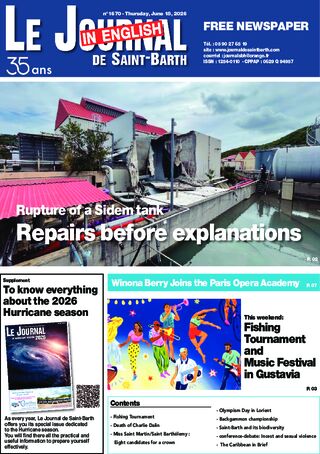
On Saturday, June 13, the walls of one of the buffer tanks at Public’s drinking water treatment plant ruptured, causing several hundred cubic meters of water to escape and damaging water pipes and the fuel supply line to the EDF power plant.
The morning of Saturday, June 13, began peacefully in the Public area. But shortly after 8 a.m., chaos ensued—if only for a few seconds. For reasons that remain unclear at this time, the walls of one of the buffer tanks at the Sidem drinking water treatment plant exploded. Sections of concrete walls collapsed, and hundreds of cubic meters of water poured into the Rubis industrial zone. As for the concrete slabs, they fell onto Sidem’s water pipes and onto the fuel supply line (the “pipe”) for the EDF power plant. This was an unprecedented industrial disaster in Saint Barthélemy that immediately had consequences for the entire population.
In fact, the production and distribution of drinking water were halted. This situation has persisted across the entire island since the accident. As soon as the reservoir rupture was reported, emergency response operations were organized. Sidem technicians were on the front lines, as were firefighters from the Territorial Fire and Rescue Service (Stis). In particular, the Rescue, Support, and Search Unit (Usar) was quickly called in to inspect the site. The territorial police, the gendarmerie, SAUR, EDF, Rubis, and the territorial authority’s services are all mobilized.
Initially, an assessment of the situation is conducted while operations are coordinated through the COT (Territorial Operations Center). This well-established structure is designed to handle various crises, even the most unlikely ones.
Water Supplies
In cooperation with the territorial authority’s services, Éric Djamakorzian, director of the Irénée de Bruyn Hospital, proceeds to completely fill the healthcare facility’s water tank using the Vitet reservoir. “We have a cistern that’s half-full,” explains the director. “In the event of a hurricane warning, we fill it completely three or four days in advance. This time, it wasn’t planned.” At the same time, the stock of bottled drinking water ordered for hurricane season is being retrieved. The hospital and the nursing home (Ehpad) can therefore continue to operate, but with restrictions. Even with full reserves, the hospital has only four to six days of autonomy.
The Collectivité is also ensuring that schools and daycare centers have sufficient water reserves. In addition, a first distribution point for non-potable water has been set up near the restrooms at the back of the Collectivité’s parking lot, and a second one in front of the Saint-Jean stadium. A third is to be set up in Lorient.
At the same time, the Collectivité’s services are organizing the distribution of bottled drinking water for the population considered most vulnerable (people living alone, families with young children, etc.). Both individuals and businesses can also have water delivered. “The water collected at Sidem is free of charge, as is the water made available in the Collectivité parking lot and the Saint-Jean parking lot,” stated Territorial Council President Xavier Lédée during one of his online posts on a so-called “social” media platform.
Delicate Operations on Site
At the accident site, firefighters from the USAR team proceeded in several stages. They worked meticulously with the assistance of a commander from the Guadeloupe SDIS—a USAR technical advisor dispatched urgently to Saint-Barthélemy—and in collaboration with personnel from Sidem, Rubis, and EDF. Since the area is classified as ATEX (an explosion-hazard zone due to the storage of flammable materials), strict safety measures had to be implemented.
Thanks to equipment from Rubis and explosimetry devices, the site was placed under constant surveillance. Two rangefinders brought from Guadeloupe were also used to detect any structural movements and prevent the risk of collapse. The firefighters were thus able to install shoring to stabilize the concrete beams. Next, the collapsed sections of wall were cut away and removed using a crane imported from Saint Martin. This first phase concluded yesterday, Wednesday, June 17.
The second phase—repairing the damaged equipment—is therefore set to begin this Thursday, June 18.
Pipes to Be Replaced
For Sidem, in addition to the loss of a buffer tank that held water produced and treated before being sent to the Colombier water tower, two suction pipes were damaged. Fortunately, replacement parts are in stock on the island.
As for EDF Archipel Guadeloupe, Pierre-Yves Gillot, the director for Saint Martin and Saint Barthélemy, confirmed as early as Monday that his teams were ready to step in to repair the damaged fuel “pipe.” “Our equipment has arrived,” the director said. “We’re waiting for the area to be secured. There’s still some administrative work to be done since the pipe that’s going to be replaced is located in the Rubis area.”
On Tuesday, a fuel delivery by tanker to resupply the power plant was postponed. The facility has about fifteen days of fuel reserves before the engines will shut down.
Consequences
For both residents and businesses on the island, the shutdown of the drinking water distribution network has had consequences. For homes and businesses equipped with water tanks, the situation is less complicated. However, it still involves constraints and difficult choices. Some establishments have significantly scaled back their operations, while others have temporarily closed to conserve their reserves (such as Nikki Beach, which was closed on Tuesday and Wednesday). For residents whose homes are not equipped with water tanks, it’s a daily struggle. “It’s not easy, but I lived through Irma, so this is nothing,” smiles a woman who came to fill bottles in front of the stadium.
In Public, with the industrial access road closed, the recycling center for residents remains shut. The same goes for the regional swimming pool in Saint-Jean.
During his online address on Tuesday, June 17, President Lédée stated that his goal was to resume water production and distribution “by the end of the weekend.” In any case, it will take several days after production resumes to replenish the network. In the meantime, conserving water and energy remains the rule.
Then it will be time to address several questions. The main one being: how could an incident of this kind have occurred?