 Français

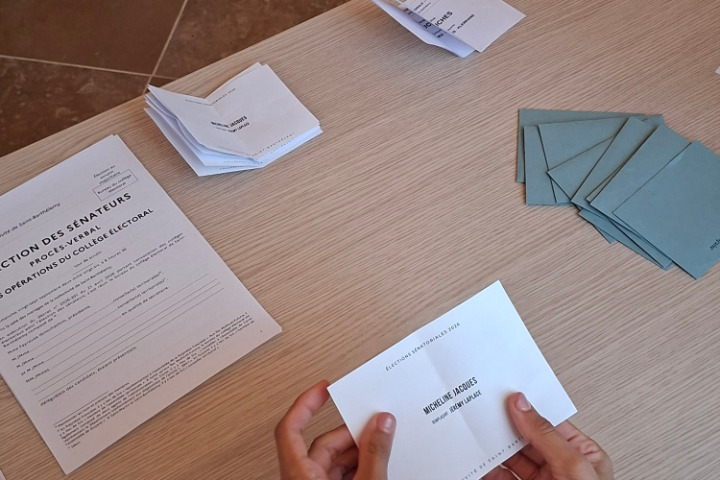
A smile is slow to appear on Micheline Jacques’s face. For several long minutes, with a serious expression, she has been watching the ballot-counting process from a red felt bench in the wedding hall of the Territorial Collectivity’s hotel. Yet the suspense is short-lived. Of the twenty-one envelopes opened by the presiding officer, thirteen ballots bear the name of the incumbent senator. The other two candidates, Maxime Desouches and Benoît Chauvin, receive only five and one vote, respectively. Finally, two ballots were declared invalid. Micheline Jacques can smile. She has been re-elected for another six years in her parliamentary term. Not without having felt a bit of anxiety in the days leading up to the election, for several reasons.

A Misleading Landslide
First of all, the pool of electors was quite different from that of 2020. The outgoing senator was Michel Magras, and the representative was Claire Guion-Firmin. Six years ago, Micheline Jacques enjoyed the support of the president of the Territorial Collectivity, Bruno Magras. This year, President Lédée’s voting intention was expressed only belatedly—and half-heartedly.
Furthermore, in 2020, Micheline Jacques was an elected official from the majority group, Saint-Barth d’Abord. However, since 2022, that same group—now in the minority within the Territorial Assembly—has been part of the opposition. Finally, to put it simply, the 2020 candidate was the sole contender for the Senate seat. This year, she had two opponents—even though they ultimately carried little weight when the votes were tallied.
The President’s Default Choice
Micheline Jacques’s uncertain position can also be attributed to the shifting stances of the president of the territorial council, Xavier Lédée. A president who was unable, unwilling, or simply failed to put forward a candidate. Perhaps out of caution, given the minority position held by his group of elected officials on the territorial council (5 out of 19). In any case, Xavier Lédée did everything in his power to make his presence felt in this election—even if it meant displaying a rare display of political clumsiness by leveling harsh criticism against the three candidates just a few days before the election (JSB 1680). All of this only to ultimately announce his intention—along with that of the elected officials in his group and Representative Frantz Gumbs—to cast their votes for the incumbent senator. This, he assured, was not “a choice based on support but a vote of responsibility.” Or, more likely, a choice by default.
One thing is certain: for at least another six months—since the territorial elections will take place in March—Xavier Lédée will have to work with Micheline Jacques. A parliamentarian who, in Paris, works in the interests of Saint Barthélemy and its residents but who, on the island as a territorial councilor for the Saint-Barth d’Abord group, remains a force of opposition. And there is no reason to believe she will not run on a slate during the campaign for the March 2027 territorial elections—a slate that will certainly not be that of the incumbent president.
For now, Micheline Jacques has already resumed her duties in the Senate—calmly, this time.

Reactions
Micheline Jacques: “Many challenges ahead”
“I accept this with great humility. I thank my colleagues for the trust they have placed in me. I have worked for the island of Saint Barthélemy, and that work has paid off. For this new term, there are many challenges to face—especially given the current national context. I will do everything in my power to defend the interests of Saint Barthélemy.”
On the 2027 territorial elections: “First, we need to assess the significance of this election. That said, it’s clear that I’m interested in being part of a slate because, in Saint Barthélemy as elsewhere, a local office allows one to truly immerse oneself in what’s happening within the Collectivity and better advocate for its issues. As I’ve been able to do on certain issues by drafting amendments in favor of Saint Barthélemy that hadn’t been taken into account. But we have to take it one step at a time. We’ll see how things look in a few months.”
On the chairmanship of the Senate Delegation for Overseas Territories: “There will be a vote for the committees and the chairs of the delegations. I’ve served a three-year term and am running for re-election. First, we need to see what the balance of power will be and how the groups will be formed in the Senate.”
Frantz Gumbs, Member of Parliament: “I followed the Lédée group”
“I had stated during the August 24 celebrations that the position of the president of the Territorial Collectivity would influence my own. I honored my commitment not to create unnecessary turmoil and aligned myself with the Lédée group’s position. Moreover, given the current national circumstances, it is unwise to create further disruption just a few months before the presidential election.”
Maxime Desouches: “I’m continuing my work as an elected official”
“As I did on the very day of the election, I extend my republican congratulations to Micheline Jacques and thank the electors who placed their trust in me. Micheline Jacques can take satisfaction in the fact that the electors have, against all odds, granted her a second chance. They did not hold it against her that her track record is difficult to assess, nor that she submitted an organic bill in October 2022 affecting our status without first informing the Territorial Council. In 2020, however, she pledged to defend our island’s vision “by working in concert” with elected officials. Her 2026 circular, moreover, acknowledges “a hesitant start” in her interactions with them. In her latest message to the electors, she assured them that she had taken note of their comments, concerns, and expectations. Let us hope that this second term will be one of action and that this commitment will be honored this time. This election also sheds light on Xavier Lédée’s position. A few days before the vote, Xavier Lédée publicly criticized the outgoing senator for providing him with little information about her work and for not including him in her meetings. He ultimately called on voters to support her. Everyone can judge for themselves the consistency of this about-face. One can’t help but wonder about the arguments—undoubtedly persuasive—that caused him to change his mind in a matter of days, in order to preserve his position as president until the end of the term. Convictions clearly have their limits. For an elected official who demanded transparency to the point of urging everyone to make a secret ballot vote public, the situation is quite ironic. It’s worth recalling that in 2022, Micheline Jacques was on the Saint-Barth d’Abord ticket, which was defeated in the territorial elections. Four years later, she was reelected with the support of Xavier Lédée’s elected officials. Those who contributed to this election and will be seeking the votes of Saint-Barthélemy’s voters in March 2027 will have to explain how yesterday’s opponent became today’s ally, only to become tomorrow’s opponent once again. The election is now behind us. Saint Barthélemy is entering a challenging period. For my part, I will continue my work as an elected official until the end of the term that voters have entrusted to us.”
Daniel Gibbs Elected in Saint Martin

Senate President Gérard Larcher with Daniel Gibbs.
Against all expectations, it is Daniel Gibbs (Les Républicains)—a former deputy (2012–2017) and later president of the Territorial Collectivity (2017–2022)—who will represent Saint Martin at the Palais du Luxembourg for the next six years. Daniel Gibbs, an opposition territorial councilor, was elected in the second round with 13 votes, compared to 11 for Valérie Damaseau, the candidate backed by the majority. He succeeds Annick Pétrus, who received only three votes in the first round before deciding not to run in the second.

The Senate Remains Predominantly Right-Wing
Micheline Jacques, senator for Saint-Barthélemy and a member of the Les Républicains party, will serve as part of the majority. In a Senate where 178 of the 346 seats were up for election, the representative from Saint-Barth will be among the 134 women elected to the Senate.
The right and center-right have 202 senators, the far right 15, the center 24, the left 74, the Greens 12, the radical left 1, and the Communists 18. Since the beginning of the Fifth Republic, the center and the right have always dominated the Senate. There has been only one exception: a brief interlude from 2011 to 2014, when the Senate swung to the left.