 Français

The end of the term is approaching, and the urgency to make progress on important issues is becoming apparent. The meeting held on Monday, September 21, to launch the drafting of the energy section of the Code of Urban Planning, Housing, and Construction is a case in point. Broadcast live on the local government’s page on a so-called “social” network, the event brought together about fifty construction professionals (architects, contractors, tradespeople, etc.) from the island.
A document by the end of the year
For Territorial Council President Xavier Lédée, the goal was to present to them the purpose of the consultations that will be conducted in the coming weeks. “By the end of the year, we need to have a formal document ready for consideration by the Territorial Council early next year to incorporate the energy provisions into our building code,” explained the elected official. “Not everything will be decided by this document alone. So we’re going to look at how we can move forward on new construction to develop an ambitious plan and to formalize the measures you’re already implementing. We’ll also need to make progress on the energy transition for existing buildings. That will take more time. Recommendations will be made, and timelines will need to be established to ensure all of this can be implemented.”
The meeting comes as major reconstruction work begins on the EDF power plant in Public. This is a project in which the Collectivité will participate financially and which will be crucial for the island’s energy future.
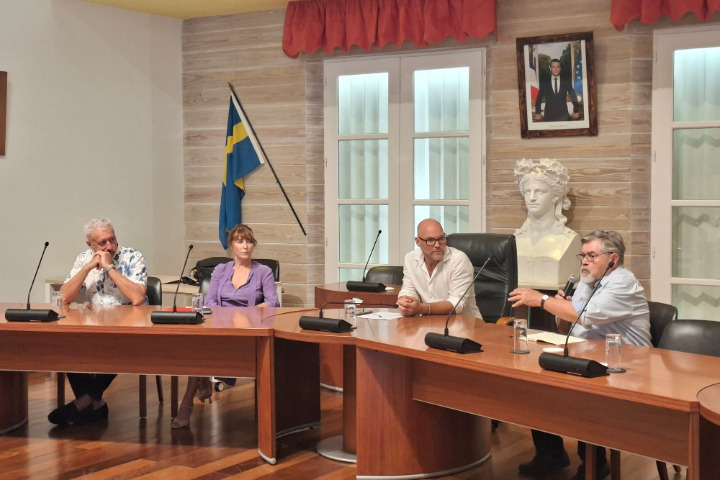
Joining President Xavier Lédée were Karine Destarac, an attorney; Philippe Baffert, an urban planning consultant; and Djamil Abdelaziz, a consultant from New Caledonia.
“We need you”
Seated alongside President Lédée is the team that will conduct consultations and gather feedback from professionals and residents (via email at energie@comstbarth.fr). It consists of Karine Destarac, an attorney; Philippe Baffert, an urban planning consultant; and Djamil Abdelaziz, a consultant from New Caledonia working for Pacific Horizon Partners. “To develop this energy component, we need you and this collaborative process,” explains Karine Destarac. “During the fifteen days we’ll be here, the goal is to organize sector-specific workshops to meet with you and gather your feedback on local specifics before getting back to you in early December.”
Ensuring the Code’s Coherence
Careful not to present himself as an “expert,” Djamil Abdelaziz specifically explained that he wanted to “draw on” the expertise of the island’s professionals. “The code must meet your expectations and needs,” he said. New Caledonia faced the same challenges. It was thanks to professionals that the territory’s energy footprint could be reduced. All of this was built through exchanges, the sharing of ideas, and debates. For this to succeed, you must get involved.” Philippe Baffert emphasized that the work has only just begun. “We must compile a list of all the documents and work that have been done so far,” he said. “Similarly, we will work with professionals. We’re not starting from scratch. What we’re going to do is incorporate elements into the construction section of a code for urban planning, housing, and construction. This is not an energy code. We need to think carefully about the coherence of this code.”
Gaining an understanding of local behaviors, familiarizing ourselves with existing systems and practices, and consulting with professionals and the public—these are the objectives of this work. “We’ll define rules, standards, and recommendations on a case-by-case basis and incorporate them into the housing and construction sections, the energy code, or the tax code if financial issues are involved—we’ll see,” explains Philippe Baffert. “We’re here to ensure that the code remains consistent.”
“The most important thing is proper use”
Pascal Peuchot, head of the Innovation and Energy Transition Division within the Collectivité, spoke to discuss the work already underway on the island. From partnerships with installers to an inventory of photovoltaic systems and storage capacity, to an update on grants awarded by the Collectivité, he provided numerous details. But the remarks that drew the most attention from the professionals in the deliberation room were those of Djamil Abdelaziz.
In fact, the expert’s presence was reassuring. “All too often, our only points of contact are lawyers,” explained an architect. “Here, we’ll be able to highlight a local, cultural perspective.” The consultant from New Caledonia calmly outlined the objectives. “We’re going to improve the building envelope’s energy efficiency and focus on usage,” he emphasizes. “Solar power is just one element among many. We’re not going to focus solely on that. The most important thing is proper usage.” ” To move toward energy self-sufficiency, Djamil Abdelaziz emphasizes the need to compile a catalog of common-sense solutions.
“The approach is sound,” says one professional as he leaves the meeting. “There are things to be done. But we mustn’t move too fast, or we risk falling flat on our faces.” Another wonders: “We also need to know if the CRE (Energy Regulatory Commission) will continue to offer subsidies. Everything is happening all at once. ” Consultations—through workshops, the review of documents, and emails from professionals and residents—have already begun. The timeline is extremely tight, as the goal is to submit a proposed code to local elected officials early next year.