Français


Sitting behind a small desk in a classroom at Mireille Choisy Middle School, Jason Siegel flashes a smile as Georgette, Elise, Armelle, Yvette, and Patrick share anecdotes sparked by the mention of words in the local dialect. For this first meeting, there aren’t many participants. Enough, however, to give momentum to the work the American linguist intends to carry out. Based in Barbados, Jason Siegel has resumed the work begun in the 1960s by Quebec linguist Gilles Lefebvre, which was later continued by Juliane Maher. Specifically, his goal is to successfully complete a dictionary project covering the patois and its variants in the “dialects” of Saint Barth. It is a vast undertaking.
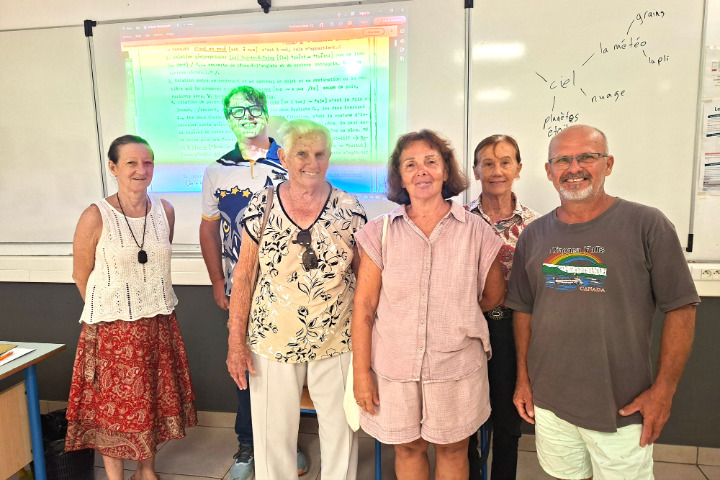
Working groups have formed around Jason Siegel, an American linguist based in Barbados, to work on a dictionary project for the patois.
Gaining the Community’s Endorsement
Since late last week, working groups have been meeting at the middle school to chat, exchange ideas and memories, and offer suggestions—all under the guidance of the linguist, who must adhere to a specific set of guidelines. “I’ve obtained the copyright to the dictionary compiled in the 1960s and 1970s by Gilles Lefebvre,” explains Jason Siegel. “I’m here today to find out what people want to do with it. I’ve already worked on some more modern entries. My goal is to create a dictionary that reflects the community’s wishes. If I write a dictionary that nobody wants, it’s a waste of time. So it’s important for the community to be involved in its development. Because creating a dictionary is like preserving cultural heritage.”
To lend him a hand and attract participants to the workshops, Elise Magras spares no effort. “I try to bring together people from different neighborhoods to get a variety of perspectives. ” For it goes without saying that the diversity of the language, even on an island as small as Saint-Barth, is vast. On the windward side, the leeward side, in Gustavia, Vitet, Grand Fond, Anse des Cayes, or Corossol—the words and expressions change. So do the stories. Like the one Armelle tells about a young man who walked all the way from Anse des Cayes to Vitet to be with the girl he was in love with. That’s how he ended up naked in a pond, thrown in there by some kids from Vitet who were jealous of him dating a girl from their neighborhood!
And then there are the nicknames. Those given to an elder but which stick around to refer to members of the same family. “We need the words, but also the expressions and the context,” explains Jason Siegel. “We get together in a group, find a word, and look for all the other words that might be related.” ” It’s a long-term project, but one carried out in a joyful and friendly atmosphere, tinged, at times, with a touch of nostalgia. “We still speak to each other in patois,” Yvette assures us. “The young people do, too.” So the patois is still far from dying out. Nevertheless, at a time when the island is often questioning its authenticity, its culture, and its “DNA,” focusing on preserving the language seems essential. This undoubtedly explains the enthusiasm of the various participants in the working groups.
On Friday, October 23, Jason Siegel headed back to Barbados. “But I’ll be back in April,” he assures us. “We’ll be working on the photos to illustrate the dictionary. Because in the original, the illustrations are just drawings, and we need to find something else.” Not to mention all the words that still need to be explored.