 Français
The playground is empty. Suddenly, the shrill sound of a horn. Then a second. But the sound fades to silence in barely two seconds. The headmistress of Gustavia's elementary school, Agnès Combin, grimaces as she looks down at the foghorn in her hand. "There's no more gas in this one, it'll have to be replaced", she observes, on this morning of October 16.
Two blasts are enough. At the signal, the pupils in the ground-floor classrooms began to evacuate calmly, following their teacher's instructions. Children with classes upstairs took refuge under the tables. Agnès Combin and volunteer firefighter Warrant Officer Aurélien Casse - who oversaw the smooth running of the test carried out during theAurélien Casse - who is overseeing the resilience day test - ensure their safety before leading them to the assembly point in the courtyard. The first stage of the earthquake simulation exercise is over.
Upstairs, we didn't quite recognize the siren; it was confusing", says one teacher. "Hence the importance of this type of training, which is compulsory every year," replies Aurélien Casse with a smile.
The seismic drill at Gustavia elementary school was organized as part of the national resilience week, and more specifically Resilience Day, which took place on October 16 this year in Saint Barth. The aim is to raise young people's awareness of the risks of natural disasters. A number of events enabled the island's schoolchildren to learn how to adopt the right reflexes, just in case.
Earthquakes, tsunamis, landslides...
The test continues at Gustavia's nursery school. The children leave their classrooms plugging their ears. Some don't hide their enthusiasm, delighted to be able to put their noses outside. Most are calm. They watch the adults, a little impressed. They seem to wonder what could be disrupting their morning of drawing and playing. Only one little girl cries out for her mommy and daddy, gently soothed by an Atsem.
A few kilometers away, the MiniSchool students have taken over the fire station of the Service territorial d'incendie et de secours de Saint-Jean. Discover the trucks, see the equipment and the rooms where firefighters train in real-life conditions... The pupils were treated to a VIP visit. "Risk awareness can also create vocations," says Emmanuelle Astier, head of the private school, with a wink.
Lily-Rose won't disagree. The young schoolgirl is convinced. "I want to be a fireman," she says. There's just one small reservation that makes her hesitate: "I'm afraid of blood..." Fortunately, she still has a few years to make up her mind. In the meantime, the visit continued with a discussion on natural hazards between the 12 students, local authority president Xavier Lédée, and the Prefect of Saint Barth and Saint Martin, Cyrille Le Vély. The first question was posed by the State representative: "So, who can give me the definition of the word resilience? "
Dedicated and involved children
Back to Gustavia. This time at the Collège Mireille Choisy. Eden Gréaux leads a workshop on the prevention of gravity-related risks. The idea is to provide information about landslides," explains the territorial technical assistant for civil security. Especially as this is a regular occurrence on the island. "The most recent example was the rockslide from Morne Depoudré on September 18, which closed the road leading from Hauts de Saint-Jean to the Petite and Grande Saline crossroads.
Divided into groups of two, the 3e class set to work. Each pair had to fill in a question sheet, looking for answers on kakemonos. "It's a dynamic format that gets them more involved," says Eden Gréaux. There's no doubt that by the end of the day, the schoolchildren will know everything there is to know about the subject.
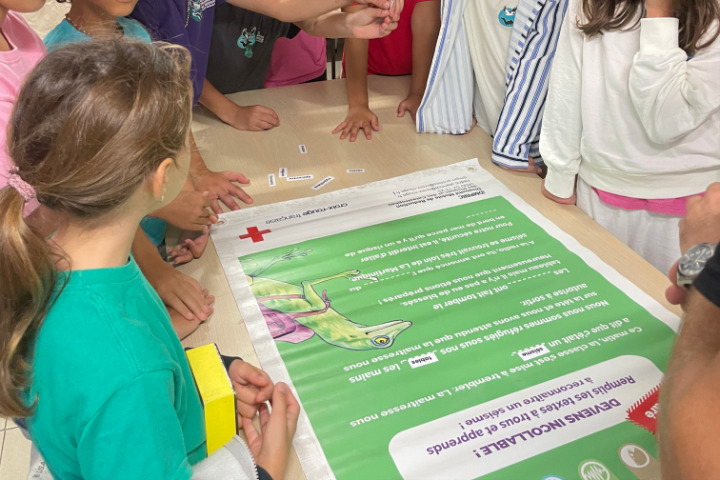
Resilience Week concludes with a final presentation on natural hazards on Friday morning at Gustavia's elementary school. It was presented by three Red Cross representatives: project leaders Joël Cardier and Cédric Jannot, and Véronique Dieste, treasurer of the Saint Barth delegation.
The children in the CM2 class study earthquakes and tsunamis for around 45 minutes. Despite their fatigue on the eve of the summer vacations, they are captivated. Every time Joël Cardier asks a question, a flock of hands goes up, their owners praying to be asked. "What are the signs of an impending tsunami? "asks Joël Cardier. "It's when the sea suddenly recedes and you can see the fish," replies a young boy with application. Real resilient kids, who will now be able to pass on their precious knowledge to their parents.