 Français

This is a significant milestone for the Louis-Vialenc Residential Care Facility for the Elderly (Ehpad). On Monday, October 5, the multi-year contract setting out objectives and resources (CPOM) was signed by Philippe Luccioni-Michaux, executive director of the Guadeloupe Regional Health Agency, Éric Djamakorzian, Director of the Irénée de Bruyn Hospital, and Xavier Lédée, President of the Territorial Council of Saint-Barthélemy.
The CPOM sets out, over a five-year period, the shared objectives between the facility, the ARS, and the Territorial Collectivity, as well as the resources allocated to achieve them. More specifically, this contract establishes the broad guidelines for the coming years in order to continue improving the quality of care for residents, respond to their evolving needs, and support the facility’s projects. “This contract sets the financial rules in stone,” explains Éric Djamakorzian. It allows us to plan for future initiatives and management efforts. For the nursing home, the CPOM means transparency, security, and quality. Adjustments will certainly be needed as the population ages and medical conditions evolve—particularly degenerative diseases. The next step will be to consider creating a secure living unit. We’ll need to recruit staff and provide housing. The gerontological plan will tell us which structure will be best suited.”
The Louis-Vialenc nursing home has a capacity ranging from 26 to 30 beds.
A New Vehicle for the Nursing Home
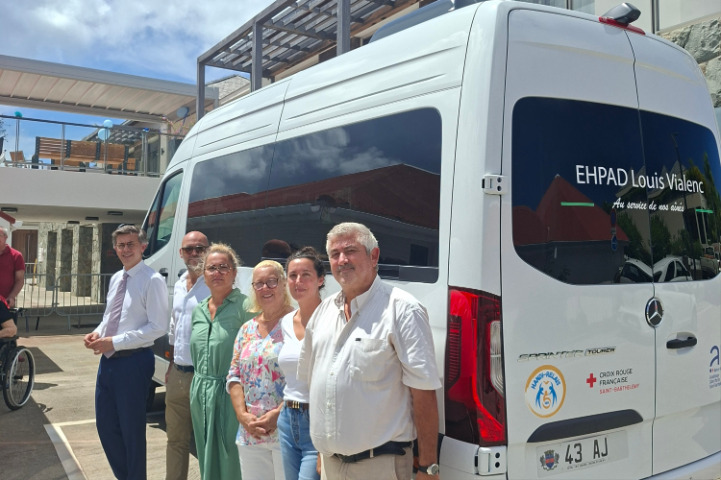
To mark the start of “La semaine bleue,” a national event dedicated to the elderly, the Louis-Vialenc nursing home officially took delivery of its new vehicle adapted for people with reduced mobility (PRM). Valued at approximately 120,000 euros, the vehicle was funded in part by the Regional Health Agency, the French Red Cross delegation in Saint-Barthélemy, the Handi-relais association, and “Les Pipelettes du Rotary,” as well as by the nursing home itself. The vehicle will allow residents to engage in activities outside the facility, participate in local events, and maintain social connections. It can transport four people in wheelchairs while also providing additional seating for able-bodied patients.