 Français
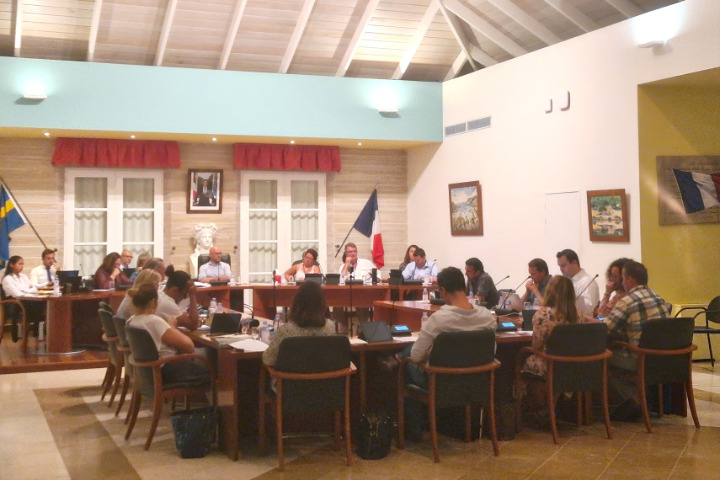
On July 13, 2023, the elected members of the territorial council voted to set up an emergency plan "to alleviate the housing crisis" on the island. This text was accompanied by a revision of the town-planning map. Since then, numerous working meetings have been organized in 2023, followed by a public meeting and a general commission in 2024. The result is a series of assessments, guidelines and recommendations. For the time being, however, no real concrete measures have been taken. This Thursday evening, the President of the Collectivité, Xavier Lédée, is convening the territorial councillors to examine a deliberation proposing the extension of the emergency housing plan. This is an opportunity for the President and the elected representatives to discuss the progress of the project. But also, and above all, for the Action-Équilibre group led by Marie-Hélène Bernier and Bettina Cointre, the opportunity to ask the Chairman for a further update on the work in progress.
Action-Équilibre's insistence
In fact, if the emergency housing plan is on the agenda for this Thursday, September 5, it is at the request of the elected members of the Action-Équilibre group. In a letter dated July 31, the group submitted a request to extend the emergency plan. But only four of the seven elected representatives (Marie-Hélène Bernier, Bettina Cointre, Jonas Brin, Maxime Desouches, David Blanchard, Dimitri Lédée and Pascale Minarro Baudoin) signed the document. However, to "force" the inclusion of a resolution on the council's agenda, it is necessary to obtain the signatures of at least a quarter of the elected representatives, of whom there are nineteen in total. After referring the matter to the prefect and submitting another request on August 13, this time signed by six of its members, the Action-Équilibre group won its case.
For the record, article 1 of the deliberation of July 13, 2023 stipulates that the urban planning commission is responsible for drawing up and proposing, "within a maximum period ofone year from the date of the deliberation", a comprehensive project including regulatory provisions to be incorporated into the town planning, housing and construction code.
Despite the fact that a series of working meetings will be held in 2023 and early 2024, the Action-Équilibre group believes that "the important work carried outs during the year have shown through the various consultations that the measures envisaged are not sufficiently mature to propose an emergency plan". It also considers, as indicated in the draft deliberation submitted to President Lédée, that "other provisions should be studied at the level of the regulations themselves".tudied at the very level of regulations concerning land-use jurisdiction and its consequences for the island's development". And to cite as examples the saturation of the road network, water and electricity consumption, waste production, embankments and so on.
Recommendations dated 2019
In the list of findings formulated by the Action-Équilibre group, one main problem emerges. "The problem of housing turns out to be one of controlling the development of the territory, which requires a broader debate in order to put in place more restrictive reThe problem of housing turns out to be a problem of controlling the development of the area, which means broadening the debate to introduce more restrictive regulations in terms of land authorization for anything that is not a primary or secondary dwelling," asserts the group, which draws on the consultations and reflections carried out in 2023. And it mentions the recommendations of the French Economic, Social, Cultural and Environmental Council (CESCE), drafted in November 2019: slow down the "frenetic pace" of construction, clarify regulations by specifying seasonal rental destinationthe AirBnb offer, and "implement real regulations for furnished accommodation on the island". These issues have been raised several times at territorial council meetings, sometimes in the form of deliberations.
It should be noted that between August 2023 and July 2024, the uses of the 251 constructions declared for building permits that have been the subject of a decision by the executive council are as follows: 104 as primary residences, 60 as primary residences and rentals, 23 as rentals, 18 as secondary residences, 18 as shops or offices, 14 as secondary residences and rentals, 5 undeclared, 4 for sale, 4 as primary residences as well as rental and secondary, one as primary and secondary.
On the agenda: a settlement agreement following the fire at the NRO premises
On June 4, 2021, a fire destroyed the premises housing the NRO (fiber optic connection node) on the first floor of the Gustavia Ehpad building. In order not to delay the installation of fiber optics on the island, the Collectivité undertook the construction of a new premises in Gustavia, on a plot of land overlooking the Sidem facilities in Gustavia. But just as the work was nearing completion, another fire broke out in the future premises. Solutech, the company responsible for the work, was given formal notice by the local authorities to assume responsibility for repairing the site. However, after consultation, the two parties found common ground and a "compromise solution". As indicated in the draft resolution to be submitted to the elected representatives of the Conseil territorial this Thursday evening, Solutech will assume the costs of restoration, for an announced amount of 593,746 euros. The Territorial Council will vote for or against this proposal at its meeting starting at 5 p.m. on Thursday.