 Français
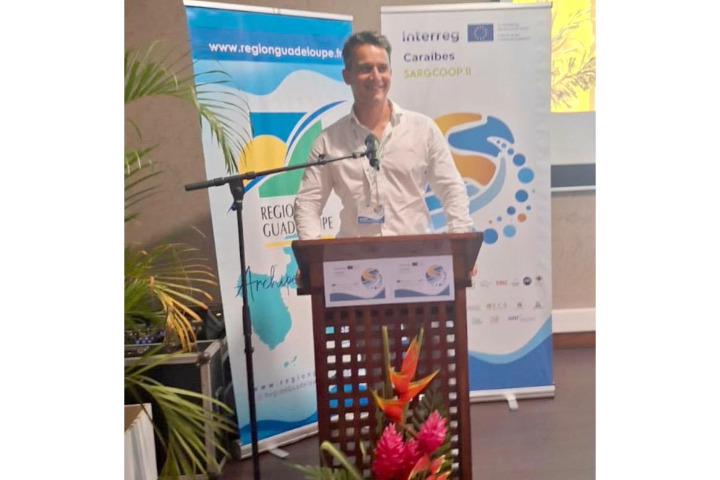
Every year, they return, more invasive than ever. Sargassum, brown seaweed that nourishes vast areas of biodiversity when at sea, turns into a pest when it washes up on the shores of Caribbean islands. It goes without saying that Saint-Barthélemy is no exception. This is one of the reasons why Rudi Laplace, Chairman of the Collectivité territoriale's Environment Commission, took part in Sarg'Coop II in Guadeloupe in mid-April. This program, supported by Interreg Caraïbes, aims to strengthen territorial preparedness and resilience in the face of natural disasters. In this case, the invasion of Sargasso seaweed.
Collection budget: 1.4 million euros by 2024
The aim is to strengthen Caribbean cooperation by creating forums and tools to facilitate the sharing of knowledge and know-how in the management of Sargasso seaweed strandings. It also aims to develop an observation, monitoring and warning network. It was therefore essential for Saint-Barthélemy to take part in this event. Sarg'Coop I was created to take stock of the situation," recalls Rudi Laplace. This was followed by work and studies on the impact of Sargasso. For Sarg'Coop II, each territory presented its problems and the results of the studies that had been carried out. "
Participants, whether elected representatives or professionals involved in managing Sargasso groundings, raised the issue of the gases released when the seaweed decomposes.They also mentioned the odors and pollution they generate, the fact that they promote erosion, and the presence of heavy metals. This last point obviously needs to be taken into account when developing algae processing projects.
Deviant dams?
We were able to meet with someone from Santo Domingo working on processing," explains Rudi Laplace. I learned that South Korea is considering investing in Colombia to set up a sargassum development laboratory, and that Martinique is going to launch a project to make compost from around 30% sargassum. "But for the territorial councillor, one of the priority avenues to explore for Saint-Barthélemy is that of deviating dams.
We have been able to gather feedback on the use of these booms," he points out. And, more broadly, on offshore collection and treatment. I'd like to find a solution with deviating weirs. Thanks to certain systems, they could also generate electricity using the action of the swell on the buoys. We'd be protected and benefit from this energy at the same time. "However, Rudi Laplace wonders about the possibility of recovering these floating devices in the event of an approaching cyclone or storm, for example. In 2024, the Collectivité spent 1.4 million euros on the collection and treatment of sargassum," he explains. Investing this budget in a system that lasts and protects us from sargassum would be preferable. "
Avenues for recycling
Rudi Laplace also mentions "several avenues for local recovery of sargassum" being explored by the Collectivité. These include methanization to produce energy from a mixture of seaweed, sewage sludge and organic waste. But it could also be transformed into biochar for "soil enrichment or co-incineration to produce drinking water via our incinerators". Under an online publication by the Saint-Barth d'Abord group, to which Rudi Laplace belongs, which reports on these "avenues of valorization", entrepreneur Pierre-Antoine Guibout (recently elected to the Cem on the "Entreprendre et Réussir SBH" list) writes: "I think that finding a solution for the sake of finding a solution is a bad idea. We now know that sargassum contains heavy metals, unless we can capture it off our coasts... Composting is therefore a false good idea, as it would pollute soil that is already partly contaminated. "In Martinique, however, the Holdex Environnement company uses algae mixed with other raw materials as a microorganic fuel (rich in trace elements) for fertilizer production. Also in Martinique, the Collabioration company has opened a laboratory, Sarg'Invest, dedicated to research into the industrial valorization of sargassum. Its mission is to transform the biological pollution of sargassum into "a source of innovation and customized solutions".
Two MPs on a mission
On Wednesday April 30, MPs Olivier Serva (Guadeloupe, LIOT) and Mickaël Cosson (Brittany, Les Démocrates) presented the conclusions of a mission to study the valorization of Sargasso seaweed. In addition to the purely environmental observations already mentioned, the parliamentarians emphasized the development potential of the algae market worldwide. Olivier Serva pointed out that, with its overseas territories, France has the second largest exclusive economic zone in the world. They therefore advocate using sargassum to develop the economy through its valorization. But how, and targeting which sector of activity? The possibilities are numerous. Provided they don't run up against technical difficulties, costs and regulatory constraints.