 Français


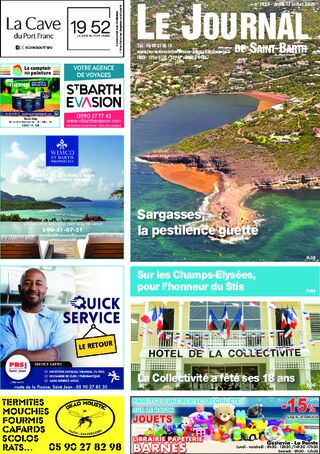
While Météo France forecasts "a fair number of groundings" over the next few days, sargassum is piling up in certain areas of the island. Like in Marigot, where part of the neighborhood is breathing in a pestilential stench.
The smell seems heavy, as heavy as a blanket you can't get rid of. Pestilential odors that sometimes mislead local residents. "I know the neighbor across the street had problems with his septic tank, and I thought it was coming from there," says one resident. A quick discussion avoids a neighborly conflict. For the smell is indeed coming from the Marigot cove. A huge slick of sargassum covers part of the bay. This slick is made up of a series of seaweed shoals that have drifted with the currents, ending up on and beside the beach. The pile of rotting matter is so great that the work of the driver at the controls of the small excavator plunged into the stranded sargassum seems akin to the marine version of Sisyphus' punishment. As for the smell, it's as persistent as it is unbearable. "It's been going on for weeks now, and we're beginning to wonder if anything is going to be done about it," complains a local resident.

"The arrivals are getting stronger
According to the latest Sargasso monitoring bulletin published on Tuesday July 15 by Météo France, the situation is not likely to improve in the immediate future. Indeed, while currents have enabled some slicks to be evacuated over the past five days, further arrivals are forecast. Sargasso is still threatening our coastlines," writes Météo France in its press release. On Saint-Barthélemy, a fair number of groundings are also to be expected, but the Sargasso rafts are likely to be a little smaller. Arrivals are increasing. The number of detections and their density are increasing, and the risk of groundings remains high over the next 15 days. "It now remains to be seen where these wandering algae will end their drift. Probably in the same areas as usual.
"No bay is safe
Last Sunday, July 13, residents of the Flamands district were unpleasantly surprised to see imposing slicks of sargassum washing up on the beach. Throughout the morning, the seaweed accumulated on the sand, sometimes forming veritable mounds. Fortunately, the force of the sea and currents allowed a large proportion of the invaders to evacuate naturally. At least in Flamands, because in reality, all the sargassum washed ashore ended up in Petite Anse or Colombier. No bay on Saint-Barthélemy is safe," noted the Saint-Barth d'Abord group online. While priority is often given to areas with high economic stakes, it is essential not to neglect the bays that are part of our daily lives or our natural heritage: Anse des Cayes, the living environment for many families, or Petite Anse like Marigot, the heart of our nature reserve, must not suffocate under brown algae. "However, this has been the case for several weeks now.
In Anse des Cayes, the amount of sargassum washed up on the beach is impressive. Despite regular collection and investment by the Le Manapany hotel, the arrivals seen over the past few weeks have failed to stem the tide.

In Flamands, on Sunday July 13.
A call to mobilize the population
In Grand-Cul-de-Sac, on the beach next to the Rosewood Le Guanahani hotel, a small tractor cleans the beach several times a day. In Barthélemy, on the other side of the lagoon, even though the situation has improved, pick-up operations continue. On Thursday, July 10, the neighborhood referent for Grand and Petit-Cul-de-Sac as well as Toiny, Turenne Laplace, called on the Island Nature Experiences (INE) association to push back the seaweed that had washed up on the top of the beach, opposite the Sereno. Pierre Andrieux, marine ecosystem restoration project manager at INE, was one of the volunteers who came to move the sargassum, pitchfork in hand. The problem is that when this sargassum washes ashore, especially in Grand-Cul-de-Sac Bay, it sometimes goes back into the water with the tide when it's high," explains Pierre. It suffocates the lambis. We found lots of dead ones this morning. The sea grass beds are also affected, as are the turtles. "Two INE volunteers, Alexandra Le Borgne de Lavillandré and Gaëlle Charreau, as well as employees of the Ouanalao Dive company and a handful of kind souls, are lending a hand.
In Colombier, volunteers from the Rotary Club decided to mobilize to collect as much sargassum as possible using whatever resources were available. An "operation" which, according to one of the participants, deserves to be repeated with a greater mobilization at Colombier cove. "Even half a day a week," he adds. A thought that also crossed Turenne Laplace's mind for Grand and Petit-Cul-de-Sac. It would then be necessary to convince part of the population to intervene on the most affected sites to rid them of the majority of stranded algae. Before they die off.
Since the beginning of the crisis, various actions have been carried out by the local authorities. Between Friday June 27 and Tuesday July 1, an intense five-day collection operation (with the help of thirteen professional fishermen) resulted in the collection of over 9,000 cubic meters of sargassum washed up or still at sea. On Friday July 11, Prefect Cyrille Le Vely met with hoteliers and the President of the Collectivité, Xavier Lédée, to discuss the tourism and economic consequences of the phenomenon. "As soon as the Collectivité regains its full freedom of action, following the completion of the audit by the Chambre territoriale des comptes, I guarantee that all the necessary financial resources will be mobilized.will be mobilized to protect the island and its economy", stated Xavier Lédée in an online publication.
The Saint-Barth d'Abord group, through the intermediary of territorial councillor Rudi Laplace, chairman of the environment commission, points out that "the preliminary studies required to implement permanent solutions (booms, nets, etc.) are still underway.(dams, diversion nets, offshore recovery systems) were already carried out under the previous mandate and will be continued in 2023 by the Cem (Chambre économique multiprofessionnelle)."It's time to act," he adds. It's time for action, not reflection. "