 Français
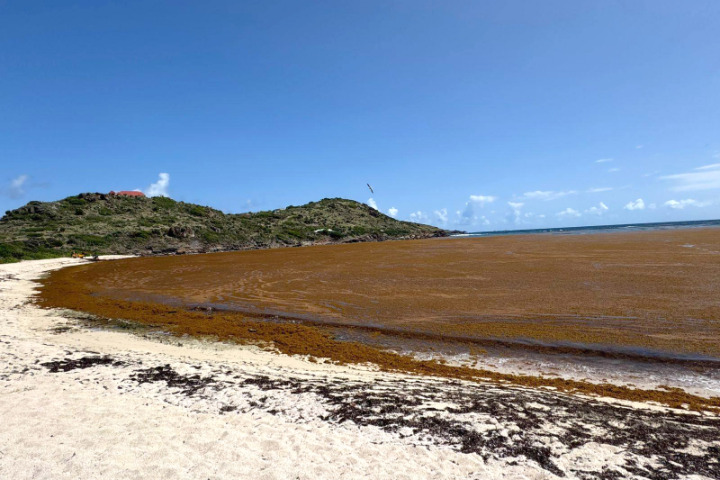
Since the start of the season, Saint-Barthélemy had been spared from sargassum. It was as if the brown seaweed, which literally assaulted Guadeloupe, had so far and quite conveniently disdained Saint-Barth. This situation changed abruptly at the end of last week. Imposing slicks of sargassum "suddenly" appeared before washing up on the beaches of the island's various bays. From Grand and Petit-Cul-de-Sac to Grands Galets (Shell Beach) and Anse des Cayes, the sand was covered with stranded algae. In some cases of impressive proportions, as in Grand-Cul-de-Sac where, on Sunday June 15, the pile of sargassum was measured at over 22 centimetres high. A veritable invasion which, while disturbing for the island's inhabitants and the few tourists still present on the island, presents far greater dangers for biodiversity.
Beach erosion
As soon as the first strandings of sargassum were reported, the local authority's technical services teams and the company hired to collect it were called in to clear the beaches of "their" sargassum. With the means at hand, i.e. small diggers, shovels and rakes. This "technique" is not without its problems in terms of beach erosion, as Sébastien Gréaux, Director of the Agence territoriale de l'environnement, points out. A few years ago, for every tonne of sargassum collected, around 300 kilos of sand were removed," he explains. There's a lot less loss today, but it's still there. It's not easy to collect the equivalent of a soccer pitch in four days. "Nevertheless, Sébastien Gréaux points out that, for the time being, "no territory has found the perfect solution". What's more, removing stranded algae as quickly as possible is not just a matter of visual or olfactory well-being, but also and above all of environmental preservation.
Herbarium and coral in danger
The director of ATE recalls the consequences, sometimes very rapid, of the arrival of an imposing shoal of sargassum. When a slick arrives, its first impact is to block out the light for the seagrass beds and corals," he explains. The seagrass and coral are then under stress and can die. Then there's the rubbing of the algae against the corals as they pass through, which damages and weakens them. And when the sargassum sinks, it's even worse. "In fact, the algae quickly enter a decomposition phase, developing bacteria that consume oxygen. "We're seeing a reduction to a lethal threshold for seagrass beds and corals," points out Sébastien Gréaux, who adds: "In Marigot, we know we're going to have mortality. But it's not just the flora. Fish will also be affected. It can be very sudden. Overnight, oxygen levels drop, causing the death of flora and fauna. "
Consequences for turtles
In addition, sargassum groundings lead to a rise in temperature. Once again, this sudden change is particularly harmful to underwater flora and fauna. Turtles are another cause for concern. Particularly those species that are in the egg-laying, and therefore reproductive, phase. Leatherback turtles, for example, of which several specimens have been spotted on Saint-Barthélemy in recent weeks, may be unable to haul themselves up onto the beach because of the obstacle posed by stranded sargassum. As for nests already in place, they may be covered over to the point of threatening hatching.
Other species reproduce in the water, leaving their eggs to drift until they settle somewhere. If they settle on sargassum, death is certain. We've seen this with diadem urchins," explains Sébastien Gréaux. Here too, the arrival of sargassum has an impact. "
On the other hand, for sea turtles and lemon sharks, which like to breed close to the coast, the danger is less. We only observed turtle mortality five or six years ago, at Grand Fond and Toiny," says the ATE director. And we've never found a dead shark, even juvenile ones. They are big consumers of oxygen, so when they sense danger, they move away from the coast. At the risk of tempting their predators. "For the latter relish the situation. Like the big tarpons that turn to grab fleeing fish. Or birds, which feed on weakened fish.
In short, sargassum is a nuisance. But, in the absence of a solution, it's a wound we'll just have to live with.
----------------------------
When the Green Overseas program stops off in Saint-Barth
Some forty representatives from the French Overseas Countries and Territories (OCTs) made a stopover in Saint-Barthélemy at the end of May, as part of the European Green Overseas program. After meeting in Saint-Martin for a week to take part in workshops on the risks of submersion and coastal erosion, they spent a day visiting Saint-Barth to take the pulse of the local situation. This "inspection" took place under the guidance of the Agence territoriale de l'environnement, with the support of the Coral Restoration and Island Nature Experience associations. Scientist Anaïs Coulon, who carried out a study on the evolution of the coastline on Saint-Barthélemy, was also on hand. This day enabled us to look back at case studies to understand how each of us manages "our" erosion," she explains. It's important because it enables us to share best practices and establishes the development of regional cooperation. "In Saint-Barthélemy, the concrete cases presented were those of the Saline and Saint-Jean beaches. Some of the actions that have been taken to curb erosion were outlined, as were the issues at stake. ATE also presented a report on the state of the corals. These meetings are expected to give rise to regional biodiversity preservation projects.

A kitesurfer trapped by sargassum in Guadeloupe
On Monday June 9, a 43-year-old kitesurfer was trapped by a slick of sargassum some 80 meters off Anse du Belley, in Sainte-Anne. The intervention of the French Civil Security helicopter (Dragon 971) was necessary to hoist the kiteboarder from the seaweed and rescue her.