 Français


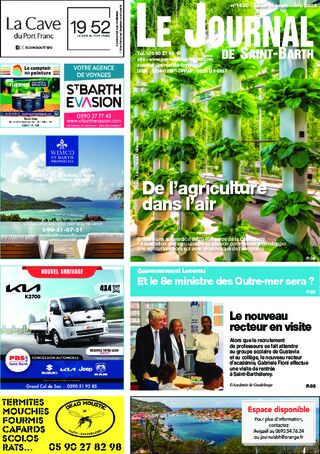
Farming on Saint-Barthélemy can be summed up in a few parcels of land, which are not easy to farm. In fact, the Farmers' Association (Apag) now has just two members. One of them is the president, Marianne Laplace, who received some excellent news at the beginning of the month. A 70,000 euro subsidy was approved by the elected members of the Collectivité's Executive Council. The grant will enable Apag to purchase 85 towers to develop vertical, i.e. above-ground, aeroponics-based agriculture.
"An opportunity for us
All this is part of the Territorial Plan for Sustainable Agriculture (PTAD, drawn up by the Chambre économique multiprofessionnelle, editor's note)," explains Marianne Laplace. These towers were for sale. We're going to be able to take advantage of them and use another method. It's a stroke of luck for us, because this equipment grant gives us a great opportunity. "Another advantage of this acquisition is that the towers won't be arriving by boat from some faraway land.
In fact, they were already present on the island. A first experiment had been launched earlier by two young entrepreneurs. "I think it didn't work out too well because they were right too soon," comments territorial councillor Maxime Desouches (Action-Équilibre), who was involved in developing the technique and obtaining the grant. This system is of great interest to the island," says the councillor. It saves water, gives predictable results and works very well. "
In schools and at the educational farm
The 85 towers will not only go to the two Apag farmers. Some will go to the island's schools, others to the educational farm," says Marianne Laplace. Others will go to the farmers. "For the two who make up Apag, but also for those who would like to start their own farm. The aim is to encourage other people, other farmers, to set up in business," insists the president of Apag. With this technique, we can hope to develop agriculture on the island. If there were more of us, it would be great. "The problem is to be able to set up somewhere. For this, the Collectivité intends to offer solutions.
A number of plots of land in the Grand Fond district are specifically earmarked for farmers. Marianne Laplace hopes that "in addition to the help with equipment, this could be a motivating factor. You have to be passionate, not lazy, but the most important obstacle is the land. And access to water, even if you get a green tariff. "
For Maxime Desouches, the acquisition of these 85 towers by Apag is an opportunity for Saint-Barth to benefit from "a system that works". He insists: "It's a system that runs almost on autopilot. There's a programmer for watering and the water is recovered and reused. It's really exciting. "
A new milestone has been reached. All that remains now is to develop the method further. But above all, we need to attract candidates for the adventure.
What is aeroponics?

©Adobe Stock /Four888
In aeroponics, plants are placed on a tray (the recovery tray) in an air-filled culture chamber (the "top aéro" lid). The roots in evidence in the culture chamber are immersed in a nebulized mineral-based nutrient solution, which is propagated at regular intervals by fixed or rotating sprays and via the action of a water pump operating in a closed circuit. The sprayed nutrient solution is recycled in the circuit, then re-injected, before being changed every 7 to 10 days (generally). A system that's both economical and ecological. Aeroponics takes up very little space, and has the added advantage of offering much higher-than-average yields. Whether in a horizontal or vertical farm, aeroponics often requires just a few square meters, which is why it is tending to develop in urban environments where space is at a premium. There is no dependence on the outside environment or the weather.
A technique born in the 1950s
Aeroponics first appeared in the 1950s. It has been developing steadily since the late 1970s. In fact, since the early 2000s, the concept of vertical farms and soil-less cultivation has won over many entrepreneurs. Particularly in countries that like to innovate and have the means to do so, it goes without saying. As in Denmark, not far from Copenhagen, where the world's largest vertical farm (over 73,000 square meters) is due to go into production before the end of the year. In Singapore, over a hundred vertical farms have already been built. There are also projects in the USA, Europe and African countries, which are developing market garden towers.
A private project rejected in Saint-Barth
In 2022, a few months after the new team chaired by Xavier Lédée took office, a project for a vertical farm using aeroponics was rejected by the elected representatives. Led by an entrepreneur based on the island, the project consisted of erecting a structure in the Saline district, for a private investment of over one million euros. The aim was to produce 10 to 15 tonnes of fruit, vegetables and herbs a year. (JSB 1473)