 Français

While he acknowledges that it is not his life’s work, Miguel Berry has been working on his book “for quite some time.” It is titled “Saint-Barth: Architecture of a Heritage.” In 98 pages, the author invites readers to delve into the history of Saint-Barthélemy’s built heritage. From traditional huts to cisterns, Swedish-style buildings, churches, and cemeteries—and, above all, the history and evolution of daily life. “I’ve been collecting documents for many years,” explains Miguel Berry. “The inventory of built heritage and the accompanying exhibition provided the opportunity to create something more comprehensive. All these buildings tell a story. They reflect a collective journey.” Through his book, published in a run of 500 copies with the support of the Territorial Collectivity and the Culture Commission, chaired by Bettina Cointre, the author aims to share accessible knowledge about “how the island has been inhabited” over the centuries. The island, but also the neighborhoods.
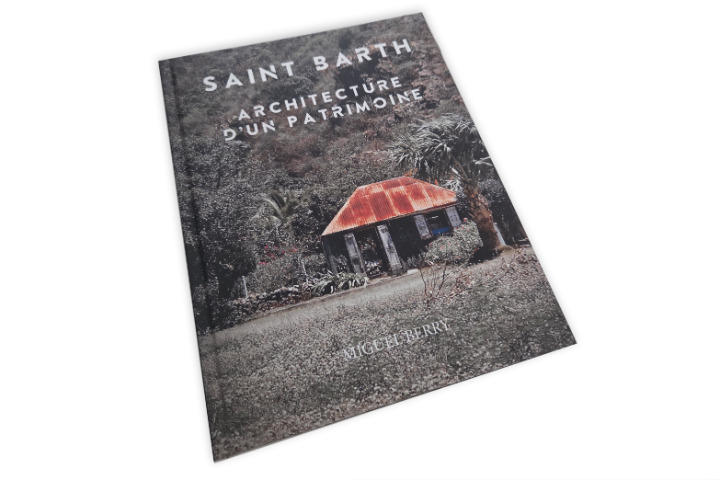
“In Gustavia, it’s more typical, with the Swedish buildings,” says Miguel Berry. “In the neighborhoods, you find structures built with available materials—sturdy and adapted to the climate.” Like the huts that are literally rooted in the ground. “That’s why these huts are still standing today, despite the passage of time and the hurricanes,” the author notes.
He also describes an austere way of life, in sturdy but small huts where families lived in two rooms. “Life took place outdoors, before a shift toward larger architecture to accommodate the whole family,” he notes.
While the small huts of yesteryear no longer seem suited to today’s lifestyle, Miguel Berry nevertheless hopes that his book will inspire architects. “In some neighborhoods, we already see clusters of small, solid-construction buildings, in the spirit of the huts, but this remains a niche compared to the number of projects,” he notes.
In any case, for those wishing to delve into the architectural history of Saint Barthélemy, the book is now on sale (40 euros) in bookstores in Gustavia (Barnes, Case aux livres), at the Brigantin Museum, and at the library.