 Français

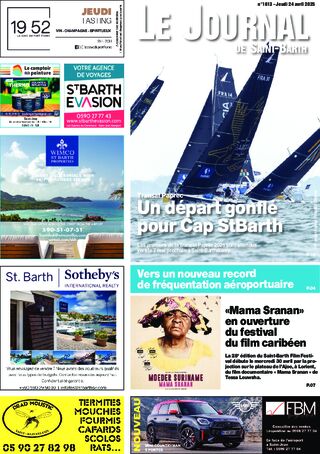
From Martinique to French Guiana, via Cuba, Haiti, colonial Algeria and Argentina. Once again, for its 28th edition, the Saint-Barth Film Festival offers viewers the chance to travel through the works that will be screened from April 30 to May 3 on the Ajoe plateau, in Lorient, and at the Théâtre du Paradis, in Gustavia. To open the event, the documentary film Mama Sranan will be shown on Wednesday April 30 at 8pm on the Ajoe plateau. The film's director, Tessa Leuwsha, will be present.
The author of several reference works on the intertwined history of Suriname and the Netherlands, Tessa Leuwsha is an iconic artist who often interweaves history with a highly personal narrative. This is notably the case with Mama Sranan, inspired by her book Fansi's silence, which recounts her grandmother's life in colonial Suriname, formerly known as Dutch Guiana, which became independent in 1975. The film received a special mention in the best documentary category at the Amsterdam International Documentary Film Festival.
Interview with the author and director.
What motivates you to explore your own story through your work, and thus immerse readers and viewers in it?
As a Dutch-Surinamese filmmaker and writer, I feel an urgent need to tell stories that remain hidden from the public, if not outright distorted or suppressed. My films and books deal with the influence and consequences of Dutch colonialism, particularly slavery, on personal lives - in Mama Sranan, I talk about my grandmother's life. In this way, I try to reveal little-known aspects of a shared Surinamese-Dutch history. In Surinam and in the Surinamese community in the Netherlands, the documentary film culture is almost non-existent. By telling my own stories, I hope to contribute to its development.
Isn't the story of Suriname, the Netherlands and, above all, of these women (and men), in many ways a story of colonization in general?
Yes, it is. Colonization took place in very similar ways all over the world, depriving people not only of their land, but also of their identity and pride. With this film, I wanted to restore part of that identity by showing an unknown black woman as a person, with her emotions, fears and hopes.
With Mama Sranan, you evoke a culture, a history and a language that are still little-known. Is your aim, through your work, to make them better known?
Absolutely. I really want to share the uniqueness of my culture, my history and my language. For a long time, this culture was dismissed by the Dutch, and therefore by the Western world, as marginal. But we're certainly not marginal. Secondly, I wanted to present a different view of Dutch colonial history, from the perspective of someone who was severely disadvantaged by it.
Sranan Tongo is a language spoken by hundreds of thousands of people on the Guyana Plateau and elsewhere. What can you tell us about it?
The language was created by African slaves brought to Suriname, who originally spoke their own languages. There was a great need to understand each other. Sranan Tongo incorporates elements of African languages, as well as English, spoken by Suriname's first conquerors.
How would you describe relations between the Netherlands and Suriname today? How do the Netherlands perceive the Surinamese?
I'd say the political relationship is fairly distant and pragmatic. Because of Suriname's centuries-long history as an inferior country, it's still difficult for the Netherlands to see Suriname as such. On the social front, however, there are many exchanges thanks to the common official language, Dutch, and the movement of Surinamese for work or study.