 Français

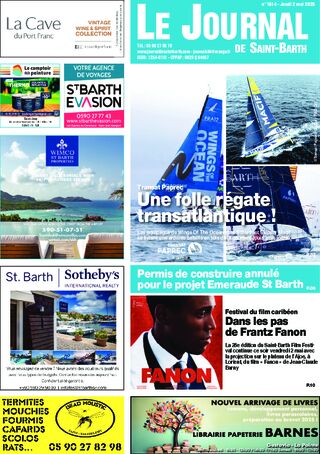
For the third evening of the 28th edition of the Saint-Barth Film Festival, this Friday May 2, the film dedicated to Frantz Fanon by director Jean-Claude Barny is screened at 8pm on the Ajoe plateau in Lorient.
The 28th edition of the Saint-Barth Film Festival kicked off on Wednesday with the screening of the profound and moving documentary film "Mama Sranan" by writer and filmmaker Tessa Leuwsha. It continued on Thursday with Jérémie Magar's astonishing "Itinéraire d'une légende" and Cyprien Vial's sultry "Magma". This Friday, May 2 at 8pm, it's one of the great figures in the fight against colonialism, psychiatrist and writer Frantz Fanon, that the festival organizers are offering to rediscover through director Jean-Claude Barny's film, soberly entitled "Fanon".
Frantz Fanon, described by Aimé Césaire as a "soldier of the universal", was born on July 20, 1925 in Fort-de-France, Martinique. After studying in Lyon, he became a psychiatrist. At the age of 18, in 1943, he joined the Free French forces to liberate France from Nazism, which he considered an affront to human dignity. But his experience proved bitter. During the war, he came face to face with racism, and realized that a France founded on universalism existed only in theory. In 1952, he published his psychiatric thesis, which he was unable to defend, under the title Peau noire, masques blancs. A first essay on the relationship between colonists and the colonized, it was to leave its mark on the anti-colonial struggle. In 1953, he was appointed head physician at the Blida-Joinville psychiatric clinic in Algeria. Jean-Claude Barny's film will plunge festival-goers into the heart of this period, during which he became a true anti-colonialist fighter.
"Bringing his work and words to life
Ever since I was a child, he's been a character who fascinated me, and all around me, he kept coming up in debates," confided the director in an interview on Radio France. I thought it was really the right time to try and humbly participate in making his work and his words exist. He's someone who accompanies so many people around the world. And that's what's so interesting about Fanon. "Since its release, the film has won over a wide audience, both in France and overseas. In his film, Jean-Claude Barny endeavors to show both Frantz Fanon's struggle in colonial Algeria in the 1950s, the violence of repression, and the dissensions within the National Liberation Front (FLN). A pivotal period in the life of Frantz Fanon, who espoused the cause of the Algerian independence movement.
Frantz Fanon died in the United States on December 6, 1961, at the age of 36, of lightning leukemia. "He didn't see the Algerian independence he fought for," says filmmaker Jean-Claude Barny. Long ignored or even censored in France, the works of Frantz Fanon are admired and studied in the United States and in many African countries, in particular. Psychiatrist, thinker, writer, journalist and political fighter, he asked to be buried in his adopted homeland, Algeria.
"Fanon" will be screened at 8 p.m. on the Ajoe stage, in the presence of actress Déborah François, who plays Josie Fanon, the wife of Frantz Fanon, magnificently portrayed by Alexandre Bouyer.
|
School visits |
Program (All screenings free of charge)
- Friday, May 2nd
- - Théâtre du Paradis, 3pm: "Destins d'exil", by Steve James, with director and producer Stéphanie James (2025, Guadeloupe, 52').
- - Ajoe, 8pm: "Fanon", by Jean-Claude Barny, with actress Déborah François (2024, film, France, 2h13).
- Saturday, May 3
- - Théâtre du Paradis, 10 a.m.: "Lisette Malidor", by Pierre-Yves Hampartzmoumian, with producer Barcha Bauer (2024, France, 53').
- - Ajoe, 8 pm:
- - End of the road", by Dirk Braun, with the director (2024, USA, 8'31'', English with French subtitles).
- - Adios Buenos Aires", by German Kral (Argentina, Germany, 1h30, Spanish with French subtitles).