
 Français
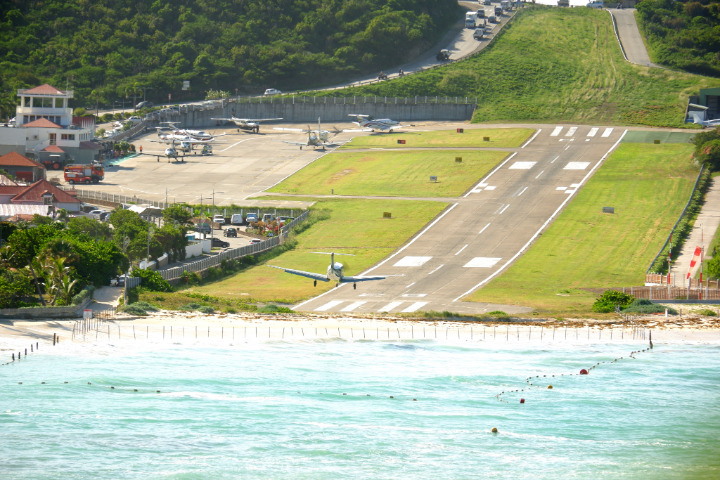
While the port is undeniably the economic and tourist heart of Saint-Barthélemy, the airport is undoubtedly one of its lungs. As a result, it's vital to ensure that it's running smoothly on a regular basis. That's why Yves Tatibouet, inter-regional director of the DSAC (Direction de la sécurité de l'aviation civile), came to meet the President of the Collectif on November 13. to meet with the President of the Collectivité, Xavier Lédée, and the Director of Saint-Barthélemy airport, Fabrice Danet. A follow-up meeting took place at the Hôtel de la Collectivité, in the presence of the Vice-President in charge of airport affairs, Marie-Angèle Aubin. During the meeting, twelve priority issues related to maintaining optimum safety levels at the airport platform were discussed.
Regional coordination
The first topic was the regulatory update of the definition of the airspace delegated to Saint-Barthélemy. "This work will enable us to catch up with the many changes that have taken place, and provide a legal basis for future operational developments," explains Fabrice Danet. To achieve this, regular consultation of published regulatory texts and the updating of aeronautical information are essential.
One of the DSAC's objectives is to strengthen its involvement in the coordination bodies of Saint-Barth airport with its counterparts in Sint Maarten, Anguilla and Puerto Rico (San Juan). Steps are being taken in this direction, with participation in coordination meetings, two of which are held each year to manage the peak tourist season. On this point, while the DSAC acts as an observer, its role is also to ensure that the decisions taken are compatible with what the airport and the air navigation service provider (PSNA AFIS) can do, "including in terms of resources", explains Fabrice Danet.
Helipads at sea
To support the desire to "smooth out traffic density", a capacity study is currently underway. Its aim is to define "the most appropriate means of coordinating the aerodrome to cope with traffic density and the risks of congestion of the ground infrastructure and airspace in flight".
On a more ambitious note, participants discussed the process of creating helipads at sea. With this in mind, Fabrice Danet emphasized "the need to reposition the DSAC as the entity that ensures consultation with all the others, and answers to the Préfecture maritime". It was agreed that the model for the creation of orders should be reviewed, with the obligation of a PPR (Prior Permission Request).PPR (Prior Permission Request) issued to airport management.
Still on the subject of helicopter activity, we were reminded that helicopters must not "hover" in their parking area.stationary" on its parking area in anticipation of departure if an aircraft is taking off or landing. An obvious point that clearly needed clarification. In this case, the priority of aircraft movements in the take-off/landing phase over helicopter movements.
Monitoring Baie de Saint-Jean
Another reminder concerns the management of boats in the Baie de Saint-Jean. The Collectivité assumes responsibility for their presence within a 300-meter radius. A protocol between the Stis (territorial fire and rescue service) and the airport enables the use of a surveillance drone. However, it was noted that a "nautical means" of intervention in the area is not permanently available. The Gendarmerie, Stis and the Agence territoriale de l'environnement still need to pool their resources.
In addition to the checks carried out on all airlines by the Direction de la Sécurité de l'Aviation Civile (Civil Aviation Safety Directorate) before the opening of the high tourist season, in particular to ensure that pilots have received the required training and can claim to be in compliance with the regulations. the requisite training and recent experience, the meeting focused on the desirability of revising the decree to revise the decree dating from 2017 which sets out the conditions of access to Saint-Barthélemy for pilots. A new requirement was adopted for helicopter pilots. In addition to theoretical ground training, they must undergo a "familiarization" flight.
Risk management
Safety being a key concern, the development of a Cash sheet (Collaborative aerodrome safety highlights) by the aerodrome operator was mentioned. Cash is a collective safety initiative, designed to draw the attention of commercial and general aviation pilots to the aeronautical context and the main threats associated with an aerodrome," says Fabrice Danet. The identification of these threats is the result of collaborative work between platform operators (air operators, airfield operators, air navigation service providers, flying clubs, Météo-France, etc.).) by comparing the elements of their safety management systems (SMS). Members of the Local Safety Team (LST) at each hub must validate this information. "
Through an online publication on a so-called "social" network, Xavier Lédée affirmed that the DSAC inter-regional director, Yves Tatibouet, " noted with satisfaction the improvements due to the work of the DSAC, but also to the responsiveness and efficiency of the Collectivité's services".